
May 10, 2013
- Ham-fisted government edict tries to shut down 3-D-printed guns, with predictable results
- “Another American century”… “Not the next Greece”… and other evidence of a resurgent imperial hubris
- Elmerraji on the “shut up and take my money” stock market… Guenthner unpacks gold’s latest thumping
- A tragicomic entry in The 5’s copper theft files… venture capital discovers Bitcoin… Mao’s prosperous progeny… and more!
 Well, it’s come to this…
“The State Department,” the PC Magazine article begins, “is forcing Defcad, known as the Pirate Bay of 3-D printing, to remove its 3-D-printable gun files, according to Defense Distributed, which runs the site.”
A quick visit to the Defcad website this morning welcomed us with this:

We were then cut short from any further inspection by a stream of blank “Service Temporarily Unavailable” pages. But not before we caught a screengrab of the culprit:

 “While Defense Distributed says it will take down the gun’s printable file from Defcad.org,” Forbes reports, “its downloads — 100,000 in just the first two days the file was online — were actually being served by Mega, the New Zealand-based storage service created by ex-hacker entrepreneur Kim Dotcom, an outspoken U.S. government critic.”
And as expected, Forbes goes on, “The blueprint for the gun and other Defense Distributed firearm components have also been uploaded several times to the Pirate Bay, the censorship-resistant filesharing site.”
Did the feds really think an edict would stop the files’ distribution?
That’s a serious case of “imperial hubris,” to borrow the expression coined by Michael Scheuer, one-time head of the CIA’s bin Laden unit.
 Indeed, imperial hubris is a running theme through the news flow of the last 24 hours…
- “The U.S. is not the next Greece,” declares Daniel Gross at the Daily Beast, noting Uncle Sam’s tax receipts are up big. Earlier this year, the scrawny codger was set to bump his hat up against the debt ceiling on May 19. Now it won’t be till Labor Day. The fiscal 2013 deficit is on pace to reach “only” $750 billion
- Then there’s the cover of the latest Economist, carrying tomorrow’s date…
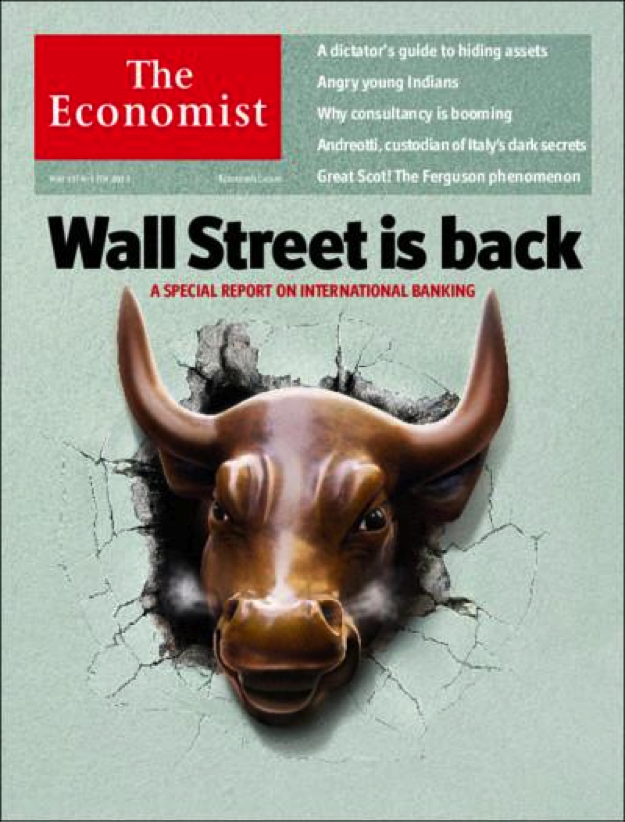
- “A new view is taking hold in elite circles,” writes Ambrose Evans-Pritchard in the London Telegraph, “that the banking crash in 2008 was a nasty shock for the U.S., but not a crippling blow to America’s creative enterprise. U.S. governing institutions rose to the challenge. It was, however, a crippling blow to Europe, and a more subtle blow to China in all kinds of ways.”
Says Richard Haass, president of the U.S. Council on Foreign Relations: The world may already be in the “second decade of another American century” without realizing it. Pritchard’s headline is “China May Not Overtake America This Century After All.”
We’re not sure what all of this swagger adds up to. For the moment, we’ll chalk it up to the “Tale of Two Americas” paradox that we’ll try to unravel this summer in Vancouver. No time like the present to make plans to join us: Early-bird registration is still available for the next three weeks.
 Record-high stock indexes are central to that aforementioned paradox… and this morning, both the Dow and the S&P 500 are only a few ticks off the all-time closing highs set on Wednesday.
At 1,628, the S&P continues to rest comfortably within an upward channel that goes back to Nov. 16 last year.
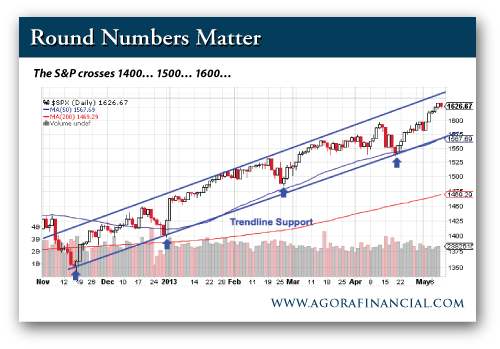
 “If May’s trading action has taught us anything,” says our trading specialist Jonas Elmerraji, “it’s the fact that we’re in a ‘shut up and take my money’ kind of market right now.
“No matter what news item, headline or data point gets thrown at the market, it keeps moving higher. Part of the reason is that there just aren’t enough sellers to appease the investors who are only now realizing they need exposure to stocks. The technicals are strong — there’s no question of that.
“The S&P plowed through 1,600 last week. The Dow took out 15,000 shortly after. Those are important round numbers that catch investors’ attention. As more and more investors try to chase performance, it’s creating plenty of opportunities for traders.
“We saw one of our open trades pop more than 50% in a single day last week,” Jonas advises — “and we got signaled to jump into a new name just a couple of days ago. We’re entering an exciting market, folks — buckle up.”
[Ed. note: Through this weekend only, we’re offering access to Jonas’ 21-Day Options Trading Challenge. You do not need experience in options trading to generate gains.
Readers who took advantage of the last challenge are still singing Jonas’ praises…
- “I pocketed $2,795 in eight days for a nice 13.5% gain,” says one
- “A 54% gain minus commissions in a week’s time is extraordinary,” says another
- “I made $1,900 minus a $14 Scottrade commission,” crows a third — “a very nice profit.”
This sort of strategy isn’t for everyone, but the only way you’ll know it’s for you is to check out what it’s all about at this link. Be advised it’s a limited-time offer, available only through midnight Sunday night.]
 The good news about gold is that it’s still $100 above its April 15 low. The bad news is it’s been whacked a good $50 in the last 18 hours.
“These are levels” writes Greg Guenthner in today’s Rude Awakening, “we haven’t seen since April 25.That’s when gold began trading in a nice, orderly horizontal channel.”
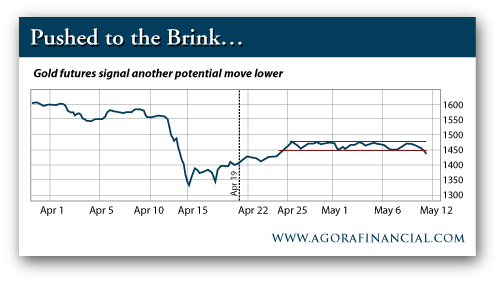
So much for all that. At last check, the bid was $1,423.
“Every asset needs time to recover after a crash,” Greg asserts. “I’m talking about a significant amount of time — not just a few days or weeks. At this point, too many investors are convinced gold can move higher from here. You’ll want to buy when everyone agrees that gold is cooked.”
 Some of gold’s weakness is a function of dollar strength. At 83.4, the dollar index sits this morning at a nine-month high.
Yesterday, the Japanese yen crossed a milestone: For the first time in four years, it takes more than 100 yen to equal one dollar. Last fall, it took only 77.
 Two miscellaneous notes that go to show what a nutty zero-interest-rate world looks like…
- Junk bond yields hit an all-time low this week, below 5%. Investors fed up with less than 2% on a 10-year Treasury note are stepping far out on the “risk curve” — driving up junk bond prices, thus driving down their yields
- University endowments are bailing on their Treasuries. “Treasuries were a core holding,” one university fund manager tells the Financial Times. “Now everyone is holding less than 5%.” Princeton has converted its Treasuries to cash. Duke is shifting into U.S. dividend payers and emerging-market stocks.
“With central banks’ zero interest rate policies firmly in place,” says our macro strategist Dan Amoss, “investors must look harder and harder to find reliable sources of portfolio income. A stock with potential to increase its dividend over time can be an attractive income source.”
Many of those blue chips trade at high valuations, but Dan spotlights one with unrecognized potential for dividend growth in today’s 5 Min. Forecast PRO. You haven’t gone PRO yet? You can get started right here.
 Copper prices sit at $3.31 a pound this morning. This harbinger of worldwide economic strength has bounced smartly off lows below $3.10 only last week.
And it’s still in high demand among thieves. The latest entry in The 5’s years-long chronicle of copper thefts comes to us this week from Thurmond, W.Va. Police say a man shot down a live power line, figuring he’d strip the line of the copper wiring and sell it for scrap.
He was electrocuted the moment he picked up the line.
Cynics would call this a case of “thinning the herd.” We are not cynics around here…
 “This is going to be a trigger point,” venture capitalist Fred Wilson tells The Wall Street Journal. “You’ll see lot more venture money being poured into this space.”
“Digital currency, and Bitcoin specifically, is a very interesting area where if one were to get it right,” Wilson says, “the upside would be enormous.”
Wilson’s firm, Union Square Ventures, just dropped a whopping $5 million on the 11-month-old Bitcoin service startup Coinbase. This tops last month’s investment into OpenCoin Inc., another virtual currency startup, by $3 million.
 “It is completely crazy that money is not borderless,” says prospective venture investor Chi-Hua Chien of Kleiner Perkins Caufield & Byers. “This is super-logical.”
The goal is to establish Bitcoin as a legitimate global currency. And the sentiment in the startup world is that it’s not as far-fetched as people might think.
“Hackers are the animals that can detect a storm coming or an earthquake,” says startup guru Paul Graham, whose Y Combinator “seed accelerator” is responsible for funding over 500 startups since 2005.
“They just know,” Graham goes on, “even though they don’t know why, and there are two big things hackers are excited about now and can’t articulate why — Bitcoin and 3-D printing.”
[Ed. Note: These happen to be the two things we’re striving to explore this year. That is, with the help of the Laissez Faire Club’s Bitcoin Bible and Chris Anderson’s keynote speech at our upcoming Vancouver Symposium, “A Tale of Two Americas.”]
 Mao Zedong, the founder of Red China, might be spinning in his grave at warp speed.
Turns out Mao’s granddaughter Kong Dongmei and her husband are ranked No. 242 on a list of rich Chinese compiled by the magazine New Fortune. Their combined net worth — 5 billion yuan, or about $815 million.
The reaction on Sina Weibo, the Chinese Twitter, has been furious, in both senses of the word. Said one government official: “The offspring of Chairman Mao, who led us to eradicate private ownership, married a capitalist and violated the family planning policy to give birth to three illegal children.” Yes, they appear to have run afoul of the one-child policy.
But some came to Kong’s online defense: “Kong just married a wealthy husband,” reads one post. “You can’t attribute it to Mao.”
Ah, yes, the marriage exception to Marx’s maxim “From each according to their ability, to each according to their need.” Maybe Mao stuck it in the footnotes of his Little Red Book…
 “I haven’t laughed like that reading The 5 in a while,” reads the first item as we open our inbox this morning. “The reader responses to the complaint of The 5 being too long to read were hilarious.
“I’m not the most educated person (barely made it out of high school), but rarely does it take me more than five minutes to read. I’m laughing now just thinking about it. I wish you would put out a daily 10. Thanks as always for providing me with the only must-read email that I get daily.”
 “Our country is on the financial Titanic!” reads an email that we’ve truncated considerably.
“We need certainty in the marketplace and in the business community. The only way to accomplish this is to comply with the Constitution and go back to the true gold standard.
“While we were under the true gold standard in the 1800s, the CPI increased by only 10% from approximately 1846-1913. In contrast, the CPI increased 695% from Aug. 17, 1971, to the present date. According to Ron Paul, we have lost over $2.6 trillion in purchasing power since 1945. Inflation is the cruelest tax of all.
“The reason for this email is that I am trying to start a down-to-earth, honest conversation about the foundation of our economy, our dollar. A nation’s currency is part of our sovereignty, it is part of our identity as Americans. I would appreciate a response.”
The 5: We have a couple of projects in the works along these lines. That’s all we can say right now. Stay tuned…
Have a good weekend,
Dave Gonigam
The 5 Min. Forecast
P.S. Sunday at midnight is when we cut off access to Jonas Elmerraji’s 21-Day Options Trading Challenge… in which you could collect gains like 51% in five days… or 85% in only 12 days. Act here.
P.P.S. “I am really annoyed that I’ve got to give up my weekend for this,” grumbles an anonymous bureaucrat to Reuters.
“Some of the world’s most powerful finance chiefs,” the wire service reports, “will meet in an English stately home on Friday and Saturday to try to speed up banking and finance reforms, with Cyprus’ near meltdown fresh in their minds.” Britain called the meeting of G-7 finance ministers and central bank governors last minute, for reasons still undisclosed.
There may be nothing to it… but if they make a big Sunday-night-before-the-Asian-markets-open announcement, don’t say we didn’t warn you.