
November 1, 2013
- “You can keep your plan”: A broken promise for wage slaves, too
- Your annual bill for NSA spying
- A defense manual against Obamacare, the NSA, the IRS, etc.
- Keeping a pulse on U.S. factories
- Keeping tabs on Chinese gold accumulation
- The great wine shortage… how government fails like clockwork… escaping a state of denial… and more!
 “Don’t get me wrong, that’s a shame,” says MIT economist Jonathan Gruber, “but no law in the history of America makes everyone better off.”
Mr. Gruber was an architect of both Romneycare in Massachusetts and Obamacare for the nation at large. He’s speaking about the sudden discovery that millions of Americans who buy health insurance in the individual market are getting cancellation notices.
Gruber says about 6% of the population buys insurance in the individual market and about half will have to switch to new plans with higher premiums that comply with the law. If you’re one of those 3% — roughly 9 million people — Gruber says tough s***.
Actually, what he told The New Yorker is, “We’ve decided as a society that we don’t want people to have insurance plans that expose them to more than $6,000 in out-of-pocket expenses.”
The president’s bit about “If you like your plan, you can keep it”? Well, he should’ve known better, Mr. Gruber seems to suggest.
Not least because in 2010 the Health and Human Services Department estimated 40-67% of individual customers would have to go elsewhere.
 Unfortunately, a large number of people covered by insurance at their workplace are about to make the same discovery.
That is, if they haven’t already. “Yep, it’s true, and I’ve experienced it firsthand,” a reader writes us after we solicited some feedback yesterday.
More from him and others below. For now, know that the aforementioned HHS document from 2010 projected millions of people under employer-provided plans would also have to switch.
“At that time,” writes J.D. Tuccille at Reason, “HHS estimated that 34-64% of large employer (100 or more workers) plans would lose grandfathered status by 2013, and that 49-80% of small employer (under 100 workers) plans would lose grandfathered status by 2013.”
The document has been scrubbed from the HHS website. But because nothing ever truly disappears from the Internet, it’s still available. Read it and weep…
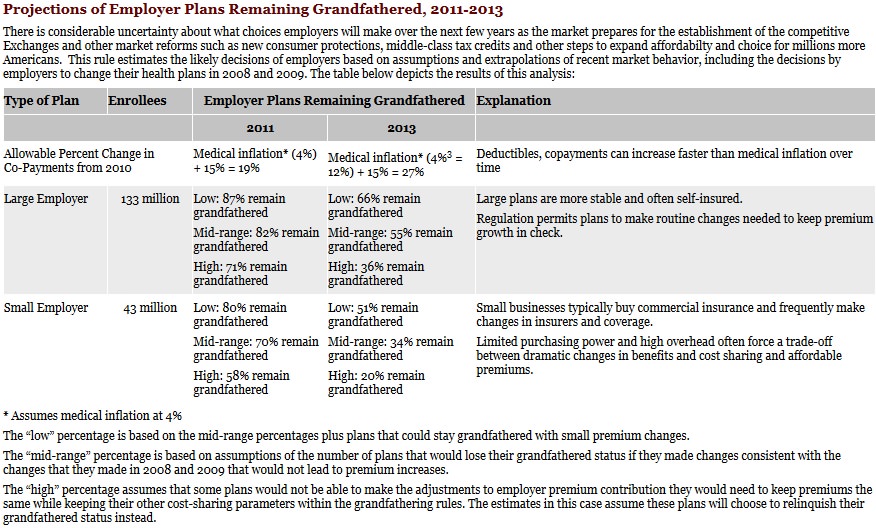
So basically half of all Americans who buy their insurance through their workplace will be in for a rude surprise. For some, the surprise has already come. For others, it won’t be till next year because the employer mandate was delayed by a year.
 If you’re the average American taxpayer, you pay the NSA $574 each year to spy on you.
Johns Hopkins economist Steve Hanke has a provocative blog post at the Cato Institute, based on the revelation earlier this year that the nation’s spying infrastructure carries a price tag of $52.6 billion.
“This is, of course, a tremendous sum,” Hanke writes — “more than double the size of the Department of Agriculture, more than triple the size of NASA; the list goes on… But what really puts this number into perspective is its average cost to each American taxpayer, or what I would call the NSA and associated agencies’ ‘rent.’
“Yes, the NSA’s rent, charged to every taxpayer living under its web of surveillance, comes out to an exorbitant $574 per year. If this is the price the federal government is charging American taxpayers to have their own privacy invaded, then I say the NSA’s rent is too damn high.”
 The good news is that people are getting fed up. Pollster Peter Hart says the nation is going through a “Howard Beale moment,” just like the 1976 movie Network. “We’re mad as hell and we’re not going to take this anymore.”
“With each self-inflicted Washington crisis,” writes Ron Fournier at National Journal, channeling the establishment’s angst, “notions such as an independent presidential bid, the dissolution of one or both major parties and the rise of new political organizations seem less outrageous. The thinking goes like this: If voters today are more empowered than ever via technology (consider the disruption of retail, entertainment and media industries), how long will they wait before blowing up the two-party system?”
Of course, we’ve never been about political solutions here — even ones that upend the existing power structure. We’re much more interested in practical solutions — things you can do right now to make your life better despite Obamacare, despite the NSA, despite the legions of busybodies who want to get in your way.
Imagine a single resource in your hands that can show you…
- How to plunk down as little as $50 a month for one-on-one access to a doctor that includes his cellphone number, same-day appointments, even home visits
- How a surprisingly cheap smartphone app gives you the power to block the NSA from listening in on your calls
- How to use a little-known “charity tax trick” that can shave $750 off your tax bill.
And there’s much more where that came from. Think of it as a tool kit with which you can declare your independence.
Best of all, there’s a way to get this resource free. Check it out right here.
 Blue chip stocks have regained a bit of the mojo they lost after the Federal Reserve’s no-news announcement Wednesday afternoon.
As we write, the Dow is up 30 points, to 15,576. But the S&P is flat at 1,756. The Nasdaq and the Russell 2000 are in the red.
Overnight, China’s official measure of manufacturing registered the strongest reading in 18 months, putting the “China slowdown” meme further to rest.
This morning, the ISM survey of U.S. manufacturing turned in its best number since June 2011 –56.4. Only five months ago, the number was below 50, signaling contraction in U.S. factories. The new-orders portion of the survey clocked in above 60 for the third straight month.
 Precious metals are sliding further as the weekend approaches. The bid on gold is $1,309. Silver’s at $21.83.
Dollar strength is definitely a factor. The dollar index is up strong again today, to 80.7, a six-week high.
 China’s gold accumulation proceeds apace.
The monthly figures for China’s gold imports via Hong Kong are in: They totaled 116.3 metric tons in September. While that’s down from the month before, the year-over-year increase is a stout 67%.

 Crude is tumbling as the week winds down. At $94.88, a barrel of West Texas Intermediate fetches the lowest price since late June.
 Call it Peak Wine: A report from Morgan Stanley forecasts a sharp increase in wine prices because production is down and consumption is up.
“World production peaked in 2004,” according to a summary on the AFP newswire, “with an excess of 600 million cases. But since then, supply has fallen because of lower production capacity, slipping in 2012 to the lowest level in 40 years, the U.S. bank said.”
Meanwhile, global consumption has been rising steadily since the late 1990s, save for a short hiccup during Panic of 2008. Per capita consumption in the U.S. has roughly doubled since the start of the century. And China has doubled its consumption twice in the last five years.
Result: Once you adjust demand for nonwine uses like vermouth, the world was undersupplied by about 300 million cases last year — the biggest shortfall since the mid-1960s. “Data suggests there may be insufficient supply to meet demand in coming years,” says the Morgan Stanley report, “as current vintages are released.”
So far the impact has been muted: “I can’t say we’ve felt any shortage,” wine buyer Mulan Chan-Randel tells the San Francisco Chronicle. “We may not be having as many closeout specials as we had during the recession, but I don’t see anyone ratcheting up the prices, either.”
Not yet, anyway…
 Despite our aforementioned efforts to help you take your power back from the bureaucrats, we’re helpless on one account this coming weekend — daylight saving time.
Unless you live in Arizona or Hawaii, you’re best off turning your clocks back an hour tomorrow night. But even on this score, we’re seeing a modest degree of rebellion against the feds.
“The actual energy savings are minimal, if they exist at all,” writes Allison Schrager at The Atlantic. “Frequent and uncoordinated time changes cause confusion, undermining economic efficiency. There’s evidence that regularly changing sleep cycles, associated with daylight saving, lowers productivity and increases heart attacks.”
And no, it doesn’t save energy — the original justification when daylight time was first imposed during World War I. In 2010, researchers from Yale and the University of California Santa Barbara examined Indiana as a case study. Much of the Hoosier state defied daylight time until the state legislature decided to conform in 2006.
The before-and-after research concluded the energy saved by less indoor light during the summer months was offset by an increase in the use of heating and air conditioning. Indeed, daylight saving time contributed to a 1% jump in electricity use.
The best laid plans…
 “Yep, it’s true, and I’ve experienced it firsthand through my employer,” writes a reader who likes his corporate health care plan but can’t keep it.
“I was recently notified that our CIGNA plan that covered both employees and families is ‘no longer offered’ and I would have to select a new CIGNA l plan with less coverage that — surprise! — has higher premiums.
“No ‘official’ explanation was offered as to the reason, but I was informed of my right to ‘opt out’ of any employer plan and receive a credit on my paycheck. And then have to sign up for coverage via HealthCare.gov? Um, no thanks…
“I’m a 5 reader from day one: Keep up the great work!”
 “I work for a large corporation,” writes another, “which was ahead of the game in setting up a health care exchange for 2013.
“We were offered the choice of five or six different ‘levels’ of coverage from five different companies. We operate in almost every state, so the number of levels and the number of companies offering probably varied from state to state. Now comes renewal time for 2014. We are still offered multiple levels, but now from just three companies. One of these companies is the same one I chose for 2013, and is offering the same plan: but at a 50%-plus increase!
“After reviewing the options, I chose to drop down one level. I’ll have more take-home pay, but will pay more for each medical visit/event. In another year, I guess the price of this lesser coverage will be the same as the much better I had for 2013.”
 “I just received my company’s sponsored update for my health insurance costs for next year,” writes a retiree insured through his former employer. “What a surprise! I got a 38% increase.
“What folks that think this new law is wonderful don’t realize is that every penny spent on additional premium costs means that those funds will not be available to spend on other things. You know, the things like food, fuel, etc. With real income down for most Americans, this will be an additional burden that they probably have not factored in.”
 “How many of your readers have their head in the wrong place and do not get any fresh air?” begins some pushback against the readers who pooh-poohed the China’s reserve currency ambitions. “Cannot they accept change?? The Chinese yuan will be in the mix of world currencies, as the dollar is, and will lose its value.
“Debt is a big factor. Why do we think we can just write our ticket on debt and everybody should accept it until they won’t? Obama has done nothing of value to the USA in the past and going forward. This Affordable Care Act is and will be a failure. Who cannot see that??? I am still for getting rid of incompetence at the White House one way or another. It is fine to talk if you have money, but most are setting back and cringing waiting to see what happens.”
 “Back in 2006, when I met my Chinese wife,” writes another, “she asked if she should transfer her money here to America. I promptly told her no, not at this time. That was when the RMB was at 8 to the dollar. Now it’s at 6 and still strengthening. That, my friends, is what is called inflation protection.”
 “For your reader who proclaims, ‘China is still a controlled state; the U.S. is not,'” chimes in a third, “should I ask just what planet this numbnut is living on? Jawohl.”
 “From my perspective,” adds a fourth, “is it not the other way round in terms of direction?
“China is maintaining, if not loosening, controls, and the U.S. is tightening. (Use a 20-year time frame and you will see the direction of each country — think tourism, for one.) I refer to…NSA, TSA and IRS and ACA and… just think, iPhone users, every time you swipe your fingerprint on the 5s, where does that image go? Spooky, eh?”
The 5: That’s a veritable alphabet soup of petty tyranny, no?
Have a good weekend,
Dave Gonigam
The 5 Min. Forecast
P.S. We direct you to our new defense manual against petty tyrants, at this link.